
Springwood Students on Track at Soap Box Derby
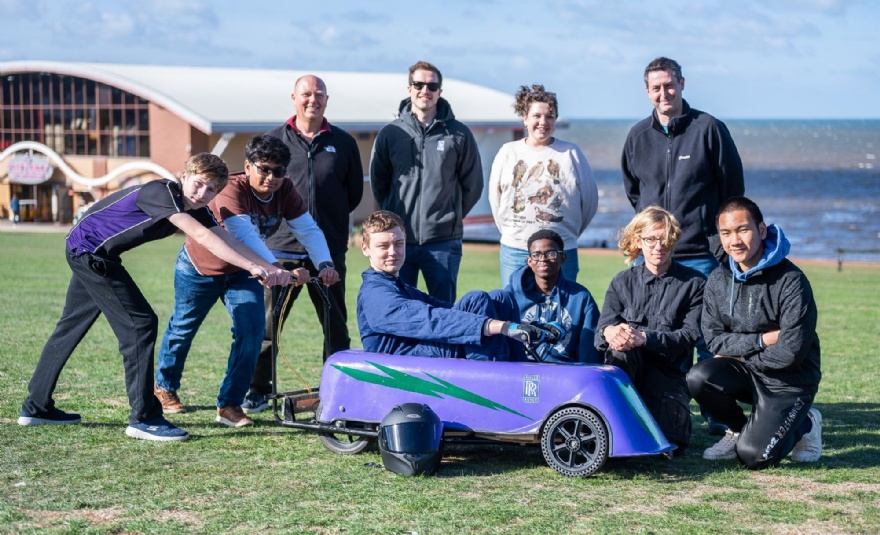
Teamwork paid off when aspiring engineers from our school put their racer through its paces at this year’s Hunstanton Soap Box Derby.
Six students from Springwood High School attended on the day, while others were involved at earlier stages in the project, which saw the group fine-tune and modify the soapbox car that had been designed and created for last year’s event.
Richard Moore ran the Science, Technology, Engineering, and Maths (STEM) club with the assistance of fellow Springwood Science Teacher Matilda Waite.
“This was the second year we had entered into the competition,” he explained. “So, unlike last year where we needed to build the soapbox from scratch, we only needed to modify it.
“They added a rear removable pushing mechanism and replaced some wooden body parts with metal to add extra strength. There was a lot of testing of the new pushing mechanism which took up most of the time.
“This mechanism was built from scrap metal – a few old school chair and table legs that the students cut down, drilled, and fitted together.”
He continued: “The group competed in the 16- to 49-year-old adults category. This was open to anybody or group of people who wanted to compete. Most came from the local area of North Norfolk, but some came from further afield.
“We sadly didn’t make it into the top three. Our fastest time was 38 seconds – the top three all had times below 30 seconds.”
Our students were once again supported by members of the Rolls Royce engineering team from RAF Marham – and there are already plans for the school, which is part of the West Norfolk Academies Trust, to race in next year’s Derby.
Mr Moore added: “We already have plans to take part in 2027. We plan on building a new soapbox so we can enter both the adult and under-16 categories. This should allow even more students from Springwood to get involved in the STEM activities.
“These clubs and events are really important for students, as it gives them the opportunity to try something new, and explore interests that they might not normally be able to from normal school life.
“It also allows them to showcase their skills and work with experts, which in turn allows them to learn new skills and improve on existing ones.”